

Inflation at 7.8%: Where to Put Your Marketing Budget Now
By Bianca Flor L. Ulan, MBA
Philippine inflation reached 7.8% in October, its fastest pace since February 2023. The headline number is what everyone will quote in budget meetings this month. The more useful number for marketers is hiding underneath it: the squeeze is landing very unevenly, and that changes who is still buying.
WHAT'S HAPPENING?
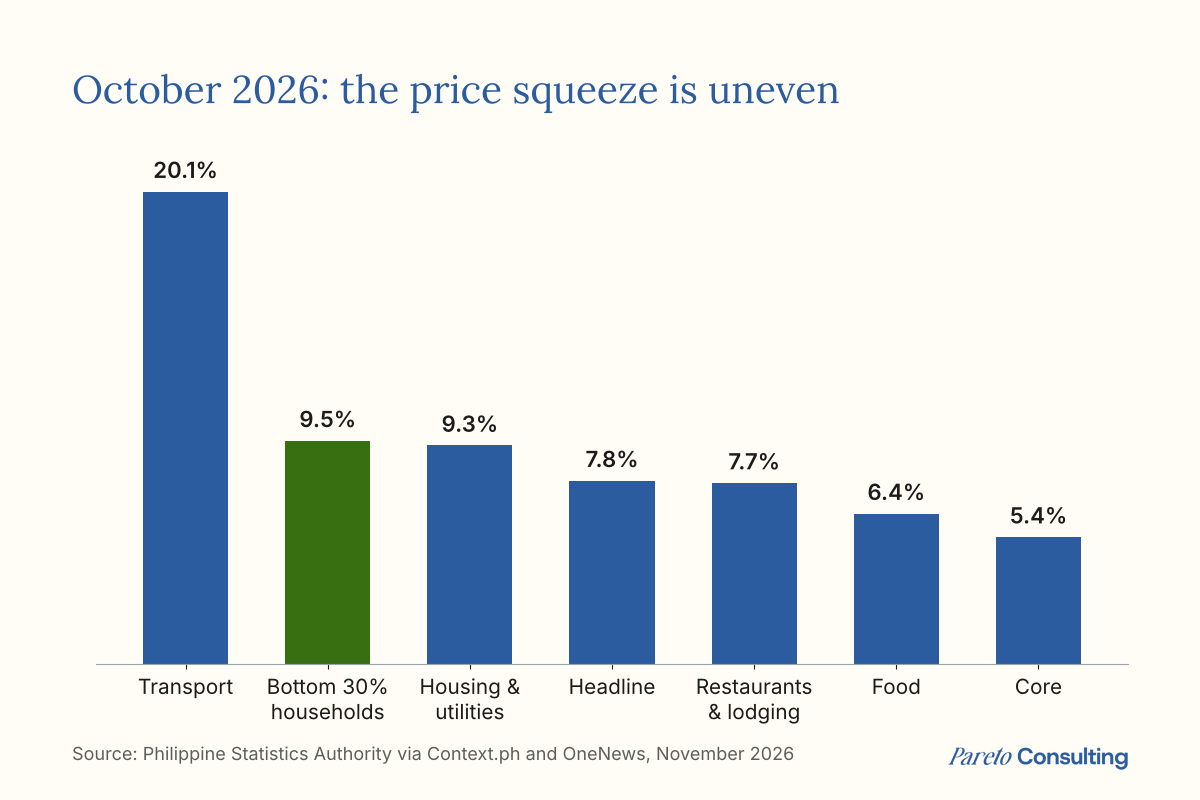
On November 5, the Philippine Statistics Authority (PSA) reported that headline inflation rose to 7.8% in October, up from 7.2% in September and well above the 1.7% of October 2025. Inflation for January to October now averages 5.6%, above the government's 2–4% target band.
The breakdown matters more than the total:
- Transport prices rose 20.1% year on year, up from 14.6% in September – the main driver of the increase.
- Housing, water, electricity, gas and other fuels rose 9.3%.
- Food inflation actually eased to 6.4%, but rice climbed 20.7%.
- Core inflation, which strips out volatile food and energy items, rose to 5.4% – a sign that price pressure is spreading.
- For the bottom 30% of income households, inflation hit 9.5%, versus 5.9% in Metro Manila overall.
The peso's purchasing power slipped to 72 centavos against 2018 prices, and the Bangko Sentral ng Pilipinas has already raised its policy rate by 50 basis points to 5.50%.
Spending data confirms the pressure. Third-quarter GDP grew just 2.1%, and household consumption – roughly three-quarters of the economy – slowed to 2.4% from 2.9% the quarter before. Retail analysts quoted by BusinessWorld expect a modest holiday lift at best, with shoppers comparing prices across stores and online platforms and favoring value-for-money categories.
WHY THIS MATTERS FOR LARGE BRANDS
If you run marketing for a listed company or a national brand, two things are probably happening on your side right now. Finance is asking you to justify every peso of Q4 and 2027 spend. And your media plan was likely built months ago on assumptions about a customer who no longer behaves the same way.
A 7.8% average hides very different realities. A commuter household spending heavily on fares and rice is living through something close to double-digit inflation. A salaried Metro Manila household with a car loan and fixed rent feels it, but differently. A business buyer is watching fuel and logistics costs eat into margins. These are three different customers with three different reasons to buy, delay or switch.
Most brand plans still treat them as one "mass market" with one message, one promo calendar and one media mix. That is where budgets leak.
MY TAKE: DON'T CUT EVENLY, RE-SEGMENT
The mistake I see most often in a period like this is the across-the-board cut. Leadership asks for 15% off the marketing budget, and every channel and campaign loses 15%. It feels fair and disciplined. In practice, it protects the weak spends and starves the strong ones.
The second mistake is reacting on gut feel – going all-in on discounting because "everyone is price-sensitive now." Some of your customers are. Some are trading down within your category. Some are still buying exactly as before, and a blanket discount just gives margin away to them.
The 80/20 lens is simple. In most categories, a minority of customer segments drives most of the revenue that survives a downturn.
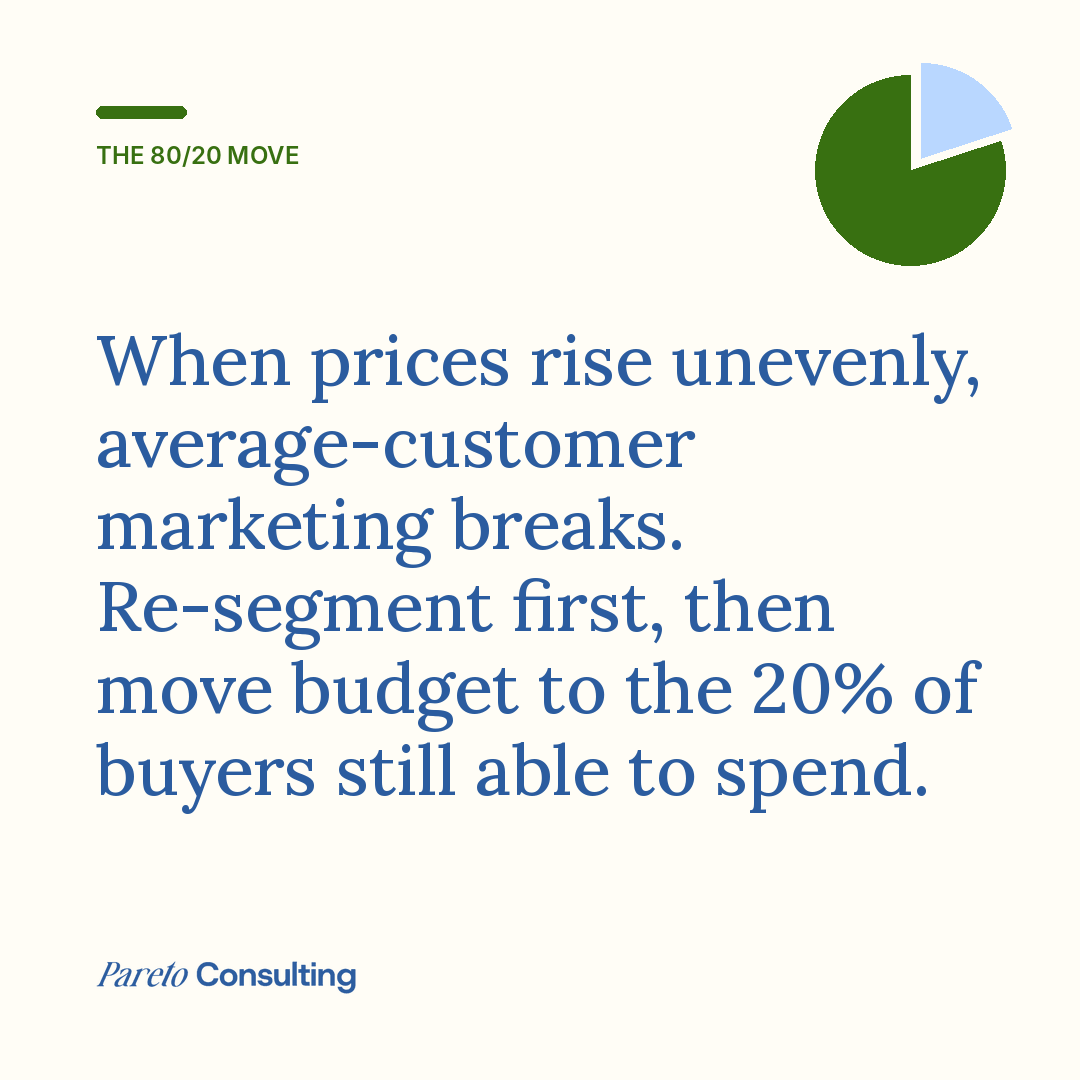
Your job right now is to find out, with data, which segments are this quarter – not last year – and concentrate your budget, message and media there. Everything else gets maintenance-level support until conditions change.
That requires knowing a few things you probably can't answer confidently today: which segments are trading down, which channels they've moved to, and what "value" actually means to them. For one segment it is a lower price point. For another it is a bigger pack, free delivery, or simply reassurance that the product lasts.
A Practical Playbook for the Next 90 Days
Map your customers against the inflation breakdown
Take your top four or five segments and estimate how exposed each is to transport, utilities and rice costs. A commuter-heavy or lower-income segment is facing a very different squeeze than the headline 7.8% suggests. This takes an afternoon with your CRM data and the PSA tables, and it reframes the whole budget discussion.
Run a fast pulse check before you reallocate
A short survey or a handful of focus group discussions per priority segment will tell you more than another month of dashboards. Ask what they've stopped buying, where they now shop, and what would make them stay with your brand. Two to three weeks is enough for a decision-grade read.
Rank every campaign and channel by cost per outcome, not reach
Line up spend against qualified leads, sign-ups or sales – whatever your business truly counts. Fund the top performers fully, and put the bottom fifth on hold. This is how you cut 15% without losing 15% of results.
Rebuild offers around each segment's definition of value
Price-led promos for the segments that need them; bundles, payment flexibility or service guarantees for those that don't. One promo calendar for everyone is the most expensive way to run Q4.
Shift media toward measurable, quickly adjustable buys
With conditions changing month to month, favor channels where you can re-target, re-budget and read results weekly – Meta, Google, TikTok and marketplace ads on Shopee and Lazada – over long, locked commitments you can't adjust.
Re-check monthly
PSA releases inflation data early each month. Put a 30-minute review on the calendar the day after each release and adjust segment priorities as the data moves.
How We Help
At Pareto, we pair market research with execution so the insight doesn't sit in a slide deck. We run competitor analysis, surveys, FGDs and field studies, then translate them into media plans across Meta, Google, TikTok, Shopee and Lazada. Our field research has taken us from counting vehicles at highway exits to interviewing more than 50 hardware store owners across Luzon – because the real answer is usually found closer to the customer than the dashboard. Brands we've worked with include Converge, Shell Pilipinas (commercial fuels), Philippine Airlines, DA-PCAF and Pioneer Adhesives.
Let’s Find Your Vital 20%
If your team is heading into 2027 planning with a tighter budget and less certainty about your customers, start with the data. Email me at bianca@paretoconsulting.ph with a short note on your category and what you need to decide, and we'll scope a focused research brief. If it's easier to talk it through, book a free 20-minute call.